
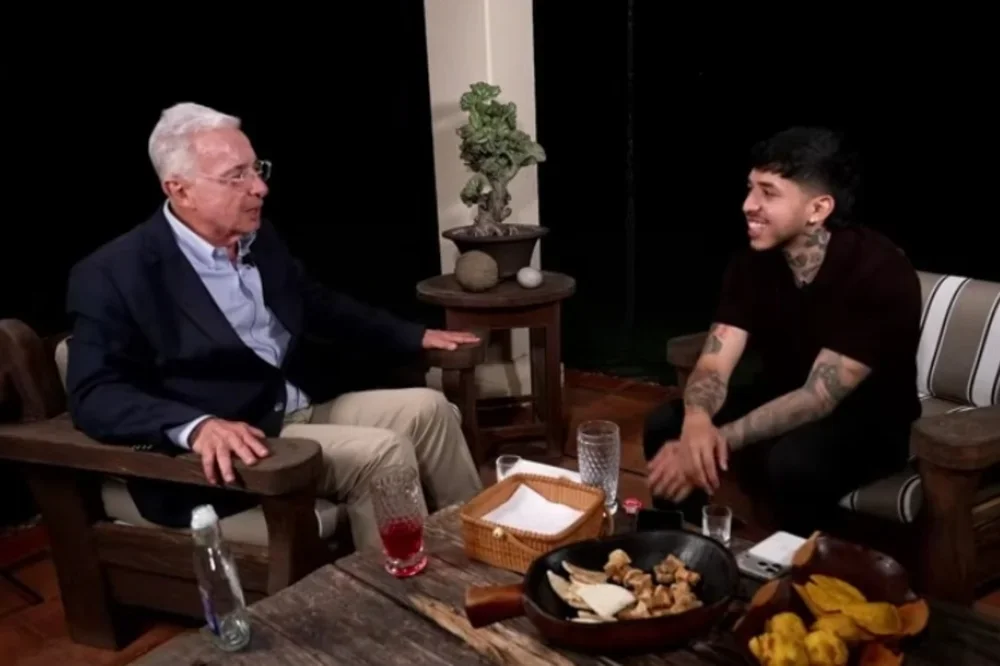
In a move reshaping political communication in Colombia, former President Álvaro Uribe Vélez opened the doors of his estate, “El Ubérrimo,” to host Westcol, the country’s most influential streamer. The live broadcast, held on Sunday, May 10, was more than just a massive online audience event—it was a generational face-off where the leader of the Democratic Center party addressed the issues that have most defined his legacy and its shadows: the false positives scandal and the stigma of being called “paraco.”
**The Weight of ‘False Positives’: ‘It Hurts Me, Even One is Serious’**
One of the interview’s highest points came when Westcol, known for his direct, unfiltered style, questioned the former president about the extrajudicial executions that occurred during his administration (2002–2010). Rather than avoiding the topic, Uribe expressed personal regret over this chapter of Colombian history.
“It hurts me a lot that there were many cases of human rights violations,” Uribe confessed to a digital audience that set connection records. Regarding the disputed figures—ranging from official records to the 6,402 cases reported by the JEP (Special Jurisdiction for Peace)—the former president was emphatic: “I don’t care. Even one is serious.”
Uribe defended his administration by stating that, upon receiving the first reports, he took corrective measures. He said he ordered the Armed Forces not to move bodies without the presence of the CTI (Technical Investigation Corps) of the Attorney General’s Office to ensure transparency. However, he acknowledged a bitter reality: “It was not corrected as early as we would have liked.”
**‘They Call Me Paraco’: The Pain Behind the Stigma**
The conversation also delved into the waters of polarization. Westcol directly asked about the label “paraco,” a term that has haunted Uribe for decades. The former president admitted that this accusation deeply affects him, especially because he believes his fight was precisely against those groups.
“Of course it hurts me,” he said. “They confused a tough security policy with paramilitarism. I dismantled paramilitarism and extradited its leaders, and not even that has served to remove the stigma.” According to Uribe, his Democratic Security strategy reduced homicides from 28,000 to 14,000 per year—an achievement he says has been “overshadowed” by the false positives scandal.
**A Nation in Mourning: Vargas Lleras and Mileidy Villada**
The interview also provided a platform for Uribe to comment on recent events that have shaken the national scene. He spoke with respect about the death of Germán Vargas Lleras, which occurred on May 8. Despite historic political differences, Uribe called him an “exceptional leader” and recalled his recent visit to El Ubérrimo as an example of democratic coexistence.
Likewise, he mourned the murder of Mileidy Villada, president of the Obando Municipal Council in Valle. With visible distress, he described her as an upright woman with a bright political future, comparing the pain of her loss to the impact he felt from the assassination of other close leaders in the past.
**A Milestone in Political Communication**
This interview marks a before and after in how traditional leaders approach new generations. Following Westcol’s recent dialogue with President Gustavo Petro, the meeting with Uribe underscores a shift in the dynamics of political engagement in Colombia.