
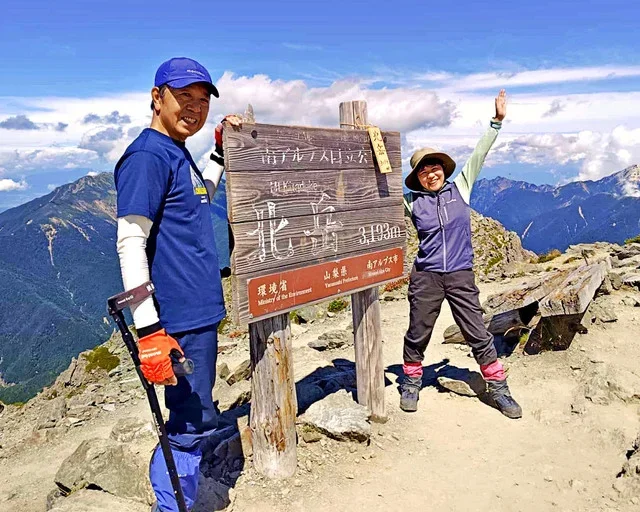
Masaharu Kuramura stands atop Mount Kitadake, one of Japan’s 100 famous mountains. He continues his unprecedented quest to conquer all 100 peaks using only one leg. (Photo provided by Kuramura)
With one leg, aiming for all 100 famous mountains of Japan.
Kuramura, known as the “one-legged alpinist,” is pursuing what is believed to be the first complete ascent of all 100 famous Japanese mountains using only one leg. He has already summitted 77 peaks. The remaining 23 include challenging mountains such as Suisho-dake, Warusawa-dake, and Poroshiri-dake—peaks that are tough even for able-bodied climbers.
At age 8, Kuramura was diagnosed with osteosarcoma and had his left leg amputated. Doctors gave him a 10% chance of survival. Yet he believes, “My destiny is to take on challenges that are possible only because I have one leg.” He has blazed trails in triathlons and mountaineering, constantly forging paths with no precedent.
In climbing, he uses crutches called “Lofstrand crutches,” relying solely on his arms and one leg to ascend. He challenges mountains on his own power, under the same conditions as ordinary climbers.
Currently, Kuramura is advancing a crowdfunding project to document his journey on film. The fundraising period runs until May 31.
The driving force behind this effort is a strong desire: “I want to leave something for the next challengers.”
Kuramura explains, “Photos can only record the fact that I reached the summit. But with video, I can show how I navigate rocky terrain with one leg, how I use my body and crutches—details that photos can’t capture.”
Mountains feature numerous difficult sections: chain routes, rocky ridges, and snowfields. Conquering them with one leg requires unique techniques and body movements.
“Many people give up on challenges because they think there’s no precedent, so it’s impossible. I want to show that with preparation and ingenuity, the impossible can become possible,” he says.
The footage is not just a record of his own achievement; it’s also meant to pass on techniques and experience to those who aspire to similar challenges.
However, mountain filming requires significant costs for specialized staff, equipment, and the accompaniment of mountain photographers. Kuramura says, “I thought if I didn’t do it now, I would regret it for the rest of my life.”
“At my age, the time I can maintain high performance is limited. That’s why I want to capture this moment as a record.”
In 2026, he plans to tackle 13 peaks including Iide-san, Chokai-san, Kankai-san, and Warusawa-dake. In 2027, he aims for 10 peaks including Poroshiri-dake, Rishiri-dake, and Hakusan.
Kuramura, who conveys the meaning of “challenging oneself” regardless of disability, now sets his sights on the remaining 23 peaks.